Anthropology optional in civil services exam is credit for its characteristics like high scoring, less syllabus, repeated questions from previous years papers etc. Hence, here I am writing down the questions and answers, chapter wise, that appeared in the previous years civil services Mains exam papers.
Syllabus of Anthropology paper -1
chapter1:
1.1 Meaning, scope and development of Anthropology.
1.2 Relationships with other disciplines: Social Sciences, Behavioural Sciences, Life Sciences, Medical Sciences, Earth Sciences and Humanities.
1.3 Main branches of Anthropology, theirscope and relevance:
(a) Social- cultural Anthropology.
(b) Biological Anthropology.
(c) Archaeological Anthropology.
(d) Linguistic Anthropology.
1.4 Human Evolution and emergence of Man:
(a) Biological and Cultural factors in human evolution.
(b) Theories of Organic Evolution (PreDarwinian, Darwinian and Post-Darwinian).
(c) Synthetic theory of evolution; Brief outline of terms and concepts of evolutionary biology (Doll’s rule, Cope’s
rule, Gause’s rule, parallelism, convergence, adapt ive radiat ion, and
mosaic evolution).
1.5 Characteristics of Primates; Evolutionary Trend and Primate Taxonomy; Primate Adaptations; (Arboreal and Terrestrial) Primate Taxonomy; Primate Behaviour; Tertiary and Quaternary fossil primates; Living Major Primates; Comparative Anatomy of Man and Apes; Skeletal changes due to erect posture and its implications.
1.6 Phylogenetic status, characteristics and geographical distribution of the following:
(a) Plio-pleistocene hominids in South and East Africa - Australopithecines.
(b) Homo erectus: Africa (Paranthropus),Europe (Homo erectus heidelbergensis) , Asia(Homo erectus javanicus, Homo erectus pekinensis).
(c) Neanderthal Man- La-Chapelle-auxsaints (Classical type), Mt. Carmel (Progressive type).
(d) Rhodesian man.
(e) Homo sapiens — Cromagnon ,Grimaldi and Chancelede.
1.7 The biological basis of life: The Cell,
DNA structure and replication, Protein Synthesis, Gene, Mutation, Chromosomes, and Cell Division.
1.8 (a) Principles of Prehistoric Archaeology. Chronology: Relative and Absolute
Dating methods.
(b) Cultural Evolution- Broad Outlines of Prehistoric cultures:
(i) Paleolithic
(ii) Mesolithic
(iii) Neolithic
(iv) Chalcolithic
(v) Copper-Bronze Age
(vi) Iron Age
1.What is Biological Anthropology?
Biological anthropology, also known as physical anthropology, is a scientific discipline in which research is concerned with the biological and behavioral variation of human beings, other non-human primates, and extinct hominin ancestors of the human species. It is a subfield of the broader discipline of anthropology, and it provides a biological perspective to the systematic study of human variation.
This branch deals with the evolution of humans, their variability, and adaptations to environmental stresses. Using an evolutionary perspective, we examine not only the physical form of humans - the bones, muscles, and organs - but also how it functions to allow survival and reproduction.
What aspects of our biology and behaviour are uniquely human and what do we share with other species? Why is there so little genetic variation among humans across the world? Are we still evolving and why has natural selection not eradicated disease? Can a statistical test save lives? These are some of the big questions Biological Anthropology tries to address by comparing humans with other animals.
As a subfield of anthropology, biological anthropology itself is further divided into several branches - Paleoanthropology, Primatology, Human behavioral ecology, Human biology, Bioarchaeology, Paleopathology, Forensic anthropology.
2. Explain Protein synthesis?.
Protein synthesis refers to the process whereby biological cells generate new proteins. The steps in protein synthesis are explained as follows.
Step 1:
The first step in protein synthesis is the transcription of mRNA from a DNA gene in the nucleus. At some other prior time, the various other types of RNA have been synthesized using the appropriate DNA. The RNAs migrate from the nucleus into the cytoplasm.
Prior to the beginning of the protein synthesis, all of the component parts are assembled in the ribosome.
Translation occurs in the cytoplasm . After leaving the nucleus , mRNA must undergo several modifications before being translated. Sections of the mRNA that do not code for amino acids, called introns, are removed.
Step 2: Initiation:
In the cytoplasm, protein synthesis is actually initiated by the AUG codon on mRNA. The AUG codon signals both the interaction of the ribosome with m-RNA and also the tRNA with the anticodons (UAC).
Step 3: Elongation:
The ribosome proceeds to the elongation phase of protein synthesis. During this stage, complexes, composed of an amino acid linked to tRNA, sequentially bind to the appropriate codon in mRNA by forming complementary base pairs with the tRNA anticodon. The ribosome moves from codon to codon along the mRNA. Amino acids are added one by one, translated into polypeptidic sequences dictated by DNA and represented by mRNA.
Step 4: Termination:
Termination of the polypeptide happens when the ribosome faces a stop codon (UAA, UAG, or UGA). When this happens, no tRNA can recognize it, and the release of polypeptide chain happens.
The newly formed polypeptide chain undergoes several modifications before becoming a fully functioning protein.

3. Discuss the modern theory of evolution with special reference to the concepts of gradualism and punctuationalism.
The neo‐Darwin view of evolution incorporates modern understanding of population genetics, developmental biology, and paleontology, to which is being added knowledge of the molecular sequencing of DNA and the insights it provides concerning the phylogeny of life. The major premises of the genetic (synthetic) theory of evolution are:
1. Evolution is the change of gene (allele) frequencies in the gene pool of a population over many generations;
2. Species (and their gene pools) are isolated from one another, and the gene pool of each species is held together by gene flow;
3. An individual has only a portion of the pool, which came from two different parents, and the portions are different in each individual;
4. The alleles the individual receives are subject to chromosomal or gene mutations and recombinations;
5. Natural selection will favor some individuals, who will then contribute a larger portion of their gene combinations to the gene pool of the next generation;
5. Changes of allele frequencies come about primarily by natural selection, but migration, gene flow, and chromosomal variations are contributing factors;
6. Isolation and restriction of gene flow between subpopulations and their parent populations are necessary for the genetic and phenotypic divergence of the subpopulations.
While most of Darwin's ideas are still very much present in the modern evolutionary synthesis, there are some fundamental differences now that more data and new disciplines have been studied. This does not, in any way, take away from the importance of Darwin's contribution and, in fact, it only helps support most of the ideas Darwin put forth in his book On the Origin of Species. The three main differences between the original Theory of Evolution through Natural Selection proposed by Charles Darwin and the most current Modern Evolutionary Synthesis are as follows:
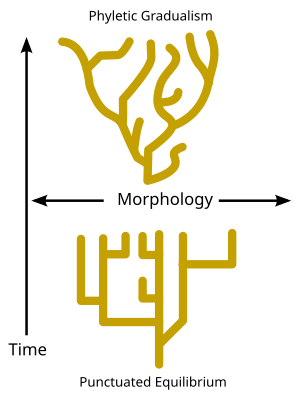
Gradualism is selection and variation that happens more gradually. Over a short period of time it is hard to notice. Small variations that fit an organism slightly better to its environment are selected for: a few more individuals with more of the helpful trait survive, and a few more with less of the helpful trait die. Very gradually, over a long time, the population changes. Change is slow, constant, and consistent.
Punctionalism:
In punctuated equilibrium, change comes in spurts. There is a period of very little change, and then one or a few huge changes occur, often through mutations in the genes of a few individuals. The species changes very rapidly over a few generations, then settles down again to a period of little change. punctuated equilibrium is any sudden, rapid change in a species and can also be the result of other causes, such as huge and sudden changes in the environment that result in more rapid changes in the organisms through harsher selection.
The idea of punctuated equilibrium originated long after the idea of gradualism. Darwin saw evolution as being "steady, slow, and continuous". Later, scientists were studying fossils and they found that some species have their evolution almost "mapped out" in fossils. For others they found a few, very different species along the evolutionary course, but very few or no fossils of "in between" organisms. Also, when dating the fossils, scientists saw that in some species change was very slow, but in others, it must have occurred rapidly to be able to produce such change over such a short amount of time.
4. Neolithic
Neolithic Period, also called New Stone Age, final stage of cultural evolution or technological development among prehistoric humans. It was characterized by stone tools shaped by polishing or grinding, dependence on domesticated plants or animals, settlement in permanent villages, and the appearance of such crafts as pottery and weaving. The Neolithic followed the Paleolithic Period, or age of chipped-stone tools, and preceded the Bronze Age, or early period of metal tools.
The Neolithic period characteristics are described as follows.
1. Environment:
The environment during this period is temperate and consists of forests, fertile valleys, plenty of forest wealth, large and small animals.
2. Technology:
a) Polishing technology
b) celts are dominant ( a polished stone axe)
c) Food production
d) Polished stone tools, mostly wheel made and to some extent hand made pottery.
e) Gained knowledge about the growth of wild crops in the Mesolithic helped the Neolithic people in selection of seeds, planting the seeds in fields, and other agricultural activities. Knowledge of domestication of dog in the previous stage provided enough experience for domestication of cattle on a large scale and harnessing them for the purpose of ploughing.
3. Social system:
a) Man became stationary; he was able to use the same site for agricultural operation; acquired permanent interest in land which served as his property. Sedentary life became a rule. The agricultural communities also grew in size. Since food production increased the villages could support large and dense population. Marital alliances and barter systems became permanent features connecting several villages of Neolithic people.
b) Division of labour was very complex as it was not only based on age and sex but also on skill and occupation specialization.
c) Inequality existed and there was formal/informal charismatic leadership; political councils came into being.
4. Religion:
a) Nature worship, ancestor worship, idol worship and polytheism existed;
5. Art
a) People used shells, fetish stones and charms for various purposes including fertility rites.
6. Homo Erectus
Homo erectus is an extinct species of hominin that lived throughout most of the Pleistocene, with the earliest first fossil evidence dating to around 1.9 million years ago and the most recent to around 143,000 years ago. The species originated in Africa and spread as far as Georgia, India, SriLanka, China and Java.
1. Ecological environment: The homo-erectus in Africa lived in open grass lands. On the otherhand, the homo-erectus in Europe and Asia lived in cold tundras and dense forests. The homo-erectus populations occupied different ecological zones and adapted to environmental challanges primarily through cultural means.
2. Physical characteristics: characteristics of homo-erectus can be grouped under two categories - Advanced and Primitive. It was because of its advanced characteristics compared to Australopithecines that it was placed in the genus Homo, and because of its primitive characteristics it was denied a rank equal to modern man and kept in a separate species - Homo Erectus.
Advanced features of homo-erectus:
a. Cranial capacity of ranges from 75 to 1421 cc.
b. Height of cranium is more than its width like modern man
c. More anterior placement of foramen magnum indicating an erect posture.
d. Dental arcade was more parabolic than Australopithecines.
e. Dental morphology was similar to modern man, as all teeth of same size and shape.
f. Tourodontism (extension of pulp cavity) present.
g. Linea aspera well developed on backside of femur.
h. sagittal crest reduced or absent
i. Parietal lobe of brain was well developed signifying development of language as means of communication and symbolic activity.
Primitive features of Homo-erectus:
a. sloping forehead as compared to vertical in modern man
b. prominent brow-ridges extending as a bar of bone across nasal root and orbits. It is absent in modern man
c. Angular occipital region. It is rounded in modern man.
d. Widest part of cranium is at the level of ears. It is higher level in modern man.
e. Bones of cranium are thick when compared to modern man
f. Larger mandible makes the face prognathic. It is smaller in modern man.
g. There is no chin but it is well developed in modern man.
h. Larger teeth and molars with divergent roots.
3. Cultural characteristics:
a. Tool traditions: The homo-erectus people were the makers of later paleolithic culture. That means homo erectus were both tool makers and tool users. Homo-erectus produced distinct techniques like bifacial tradition, chopper chopping tradition, clactonial tradition, levallosian tradition etc.
b. Fist use of fire: Homo erectus hunters were the first users of fire. The presence of charred bones during archeological evidence suggests that they used fire for cooking. Fire may also have served a number of other purposes like driving and trapping animals during hunting, for warmth during winter and cold weather, gathering point for the group etc.
c. Shelters: They used open campsites. They constructed protective shelters. Some lived in caves, rock shelters etc.
d. Food gathering: The hominids in the lower paleolithic culture were food gatherers and hunters. At Kalambo falls in Zambia, piles of gathered vegetable materials including fruits were obtained by archeologists.
e. Hunting: The hominids in the lower paleolithic were efficient big game hunters. They hunted animals like elephant, hippopotamus, rhinoceroses, zebra, buffalo, wild ox, horses, tigers, giant pig etc.
f. cannibalism: Some fractured hominid bones and skulls with enlarged foramen magnum from china indicate the technique of removal of human brains from skull.
g. Language and communication: The selective forces like fire, tool marking, hunting, group living has developed memory sites (occipital lobe), thinking sites (frontal lobe) and different motor areas (cerebral cortex ) of brain. These enabled the erectus population with symbolic behaviour.
h. Sexual dimorphism: Although females approach males in body size there is marked differences in the facial features of males and females. Males had bigger faces with more massive brow ridges like apes.
4. Phylogenetic position: It means evolutionary relations among fossil populations. The following are the alternate interpretations of the phylogenetic relationships of homo-erectus fossil forms.


7. Lower Paleolithic culture

Syllabus of Anthropology paper -1
chapter1:
1.1 Meaning, scope and development of Anthropology.
1.2 Relationships with other disciplines: Social Sciences, Behavioural Sciences, Life Sciences, Medical Sciences, Earth Sciences and Humanities.
1.3 Main branches of Anthropology, theirscope and relevance:
(a) Social- cultural Anthropology.
(b) Biological Anthropology.
(c) Archaeological Anthropology.
(d) Linguistic Anthropology.
1.4 Human Evolution and emergence of Man:
(a) Biological and Cultural factors in human evolution.
(b) Theories of Organic Evolution (PreDarwinian, Darwinian and Post-Darwinian).
(c) Synthetic theory of evolution; Brief outline of terms and concepts of evolutionary biology (Doll’s rule, Cope’s
rule, Gause’s rule, parallelism, convergence, adapt ive radiat ion, and
mosaic evolution).
1.5 Characteristics of Primates; Evolutionary Trend and Primate Taxonomy; Primate Adaptations; (Arboreal and Terrestrial) Primate Taxonomy; Primate Behaviour; Tertiary and Quaternary fossil primates; Living Major Primates; Comparative Anatomy of Man and Apes; Skeletal changes due to erect posture and its implications.
1.6 Phylogenetic status, characteristics and geographical distribution of the following:
(a) Plio-pleistocene hominids in South and East Africa - Australopithecines.
(b) Homo erectus: Africa (Paranthropus),Europe (Homo erectus heidelbergensis) , Asia(Homo erectus javanicus, Homo erectus pekinensis).
(c) Neanderthal Man- La-Chapelle-auxsaints (Classical type), Mt. Carmel (Progressive type).
(d) Rhodesian man.
(e) Homo sapiens — Cromagnon ,Grimaldi and Chancelede.
1.7 The biological basis of life: The Cell,
DNA structure and replication, Protein Synthesis, Gene, Mutation, Chromosomes, and Cell Division.
1.8 (a) Principles of Prehistoric Archaeology. Chronology: Relative and Absolute
Dating methods.
(b) Cultural Evolution- Broad Outlines of Prehistoric cultures:
(i) Paleolithic
(ii) Mesolithic
(iii) Neolithic
(iv) Chalcolithic
(v) Copper-Bronze Age
(vi) Iron Age
1.What is Biological Anthropology?
Biological anthropology, also known as physical anthropology, is a scientific discipline in which research is concerned with the biological and behavioral variation of human beings, other non-human primates, and extinct hominin ancestors of the human species. It is a subfield of the broader discipline of anthropology, and it provides a biological perspective to the systematic study of human variation.
This branch deals with the evolution of humans, their variability, and adaptations to environmental stresses. Using an evolutionary perspective, we examine not only the physical form of humans - the bones, muscles, and organs - but also how it functions to allow survival and reproduction.
What aspects of our biology and behaviour are uniquely human and what do we share with other species? Why is there so little genetic variation among humans across the world? Are we still evolving and why has natural selection not eradicated disease? Can a statistical test save lives? These are some of the big questions Biological Anthropology tries to address by comparing humans with other animals.
As a subfield of anthropology, biological anthropology itself is further divided into several branches - Paleoanthropology, Primatology, Human behavioral ecology, Human biology, Bioarchaeology, Paleopathology, Forensic anthropology.
2. Explain Protein synthesis?.
Protein synthesis refers to the process whereby biological cells generate new proteins. The steps in protein synthesis are explained as follows.
Step 1:
The first step in protein synthesis is the transcription of mRNA from a DNA gene in the nucleus. At some other prior time, the various other types of RNA have been synthesized using the appropriate DNA. The RNAs migrate from the nucleus into the cytoplasm.
Prior to the beginning of the protein synthesis, all of the component parts are assembled in the ribosome.
Translation occurs in the cytoplasm . After leaving the nucleus , mRNA must undergo several modifications before being translated. Sections of the mRNA that do not code for amino acids, called introns, are removed.
Step 2: Initiation:
In the cytoplasm, protein synthesis is actually initiated by the AUG codon on mRNA. The AUG codon signals both the interaction of the ribosome with m-RNA and also the tRNA with the anticodons (UAC).
Step 3: Elongation:
The ribosome proceeds to the elongation phase of protein synthesis. During this stage, complexes, composed of an amino acid linked to tRNA, sequentially bind to the appropriate codon in mRNA by forming complementary base pairs with the tRNA anticodon. The ribosome moves from codon to codon along the mRNA. Amino acids are added one by one, translated into polypeptidic sequences dictated by DNA and represented by mRNA.
Step 4: Termination:
Termination of the polypeptide happens when the ribosome faces a stop codon (UAA, UAG, or UGA). When this happens, no tRNA can recognize it, and the release of polypeptide chain happens.
The newly formed polypeptide chain undergoes several modifications before becoming a fully functioning protein.
3. Discuss the modern theory of evolution with special reference to the concepts of gradualism and punctuationalism.
The neo‐Darwin view of evolution incorporates modern understanding of population genetics, developmental biology, and paleontology, to which is being added knowledge of the molecular sequencing of DNA and the insights it provides concerning the phylogeny of life. The major premises of the genetic (synthetic) theory of evolution are:
1. Evolution is the change of gene (allele) frequencies in the gene pool of a population over many generations;
2. Species (and their gene pools) are isolated from one another, and the gene pool of each species is held together by gene flow;
3. An individual has only a portion of the pool, which came from two different parents, and the portions are different in each individual;
4. The alleles the individual receives are subject to chromosomal or gene mutations and recombinations;
5. Natural selection will favor some individuals, who will then contribute a larger portion of their gene combinations to the gene pool of the next generation;
5. Changes of allele frequencies come about primarily by natural selection, but migration, gene flow, and chromosomal variations are contributing factors;
6. Isolation and restriction of gene flow between subpopulations and their parent populations are necessary for the genetic and phenotypic divergence of the subpopulations.
While most of Darwin's ideas are still very much present in the modern evolutionary synthesis, there are some fundamental differences now that more data and new disciplines have been studied. This does not, in any way, take away from the importance of Darwin's contribution and, in fact, it only helps support most of the ideas Darwin put forth in his book On the Origin of Species. The three main differences between the original Theory of Evolution through Natural Selection proposed by Charles Darwin and the most current Modern Evolutionary Synthesis are as follows:
- The modern synthesis recognizes several different possible mechanisms of evolution. Darwin's theory relied on natural selection as the only known mechanism. One of these different mechanisms, genetic drift, could even match the importance of natural selection in the overall view of evolution.
- Modern synthesis asserts that characteristics are passed down from parents to offspring on parts of DNA called genes. Variation between individuals within a species is because of the presence of multiple alleles of a gene.
- The modern synthesis of the Theory of Evolution hypothesizes that speciation is most likely due to the gradual accumulation of small changes or mutations at the gene level. In other words, microevolution leads to macroevolution.
Gradualism is selection and variation that happens more gradually. Over a short period of time it is hard to notice. Small variations that fit an organism slightly better to its environment are selected for: a few more individuals with more of the helpful trait survive, and a few more with less of the helpful trait die. Very gradually, over a long time, the population changes. Change is slow, constant, and consistent.
Punctionalism:
In punctuated equilibrium, change comes in spurts. There is a period of very little change, and then one or a few huge changes occur, often through mutations in the genes of a few individuals. The species changes very rapidly over a few generations, then settles down again to a period of little change. punctuated equilibrium is any sudden, rapid change in a species and can also be the result of other causes, such as huge and sudden changes in the environment that result in more rapid changes in the organisms through harsher selection.
The idea of punctuated equilibrium originated long after the idea of gradualism. Darwin saw evolution as being "steady, slow, and continuous". Later, scientists were studying fossils and they found that some species have their evolution almost "mapped out" in fossils. For others they found a few, very different species along the evolutionary course, but very few or no fossils of "in between" organisms. Also, when dating the fossils, scientists saw that in some species change was very slow, but in others, it must have occurred rapidly to be able to produce such change over such a short amount of time.
4. Neolithic
Neolithic Period, also called New Stone Age, final stage of cultural evolution or technological development among prehistoric humans. It was characterized by stone tools shaped by polishing or grinding, dependence on domesticated plants or animals, settlement in permanent villages, and the appearance of such crafts as pottery and weaving. The Neolithic followed the Paleolithic Period, or age of chipped-stone tools, and preceded the Bronze Age, or early period of metal tools.
The Neolithic period characteristics are described as follows.
1. Environment:
The environment during this period is temperate and consists of forests, fertile valleys, plenty of forest wealth, large and small animals.
2. Technology:
a) Polishing technology
b) celts are dominant ( a polished stone axe)
c) Food production
d) Polished stone tools, mostly wheel made and to some extent hand made pottery.
e) Gained knowledge about the growth of wild crops in the Mesolithic helped the Neolithic people in selection of seeds, planting the seeds in fields, and other agricultural activities. Knowledge of domestication of dog in the previous stage provided enough experience for domestication of cattle on a large scale and harnessing them for the purpose of ploughing.
3. Social system:
a) Man became stationary; he was able to use the same site for agricultural operation; acquired permanent interest in land which served as his property. Sedentary life became a rule. The agricultural communities also grew in size. Since food production increased the villages could support large and dense population. Marital alliances and barter systems became permanent features connecting several villages of Neolithic people.
b) Division of labour was very complex as it was not only based on age and sex but also on skill and occupation specialization.
c) Inequality existed and there was formal/informal charismatic leadership; political councils came into being.
4. Religion:
a) Nature worship, ancestor worship, idol worship and polytheism existed;
5. Art
a) People used shells, fetish stones and charms for various purposes including fertility rites.
6. Homo Erectus
Homo erectus is an extinct species of hominin that lived throughout most of the Pleistocene, with the earliest first fossil evidence dating to around 1.9 million years ago and the most recent to around 143,000 years ago. The species originated in Africa and spread as far as Georgia, India, SriLanka, China and Java.
1. Ecological environment: The homo-erectus in Africa lived in open grass lands. On the otherhand, the homo-erectus in Europe and Asia lived in cold tundras and dense forests. The homo-erectus populations occupied different ecological zones and adapted to environmental challanges primarily through cultural means.
2. Physical characteristics: characteristics of homo-erectus can be grouped under two categories - Advanced and Primitive. It was because of its advanced characteristics compared to Australopithecines that it was placed in the genus Homo, and because of its primitive characteristics it was denied a rank equal to modern man and kept in a separate species - Homo Erectus.
Advanced features of homo-erectus:
a. Cranial capacity of ranges from 75 to 1421 cc.
b. Height of cranium is more than its width like modern man
c. More anterior placement of foramen magnum indicating an erect posture.
d. Dental arcade was more parabolic than Australopithecines.
e. Dental morphology was similar to modern man, as all teeth of same size and shape.
f. Tourodontism (extension of pulp cavity) present.
g. Linea aspera well developed on backside of femur.
h. sagittal crest reduced or absent
i. Parietal lobe of brain was well developed signifying development of language as means of communication and symbolic activity.
Primitive features of Homo-erectus:
a. sloping forehead as compared to vertical in modern man
b. prominent brow-ridges extending as a bar of bone across nasal root and orbits. It is absent in modern man
c. Angular occipital region. It is rounded in modern man.
d. Widest part of cranium is at the level of ears. It is higher level in modern man.
e. Bones of cranium are thick when compared to modern man
f. Larger mandible makes the face prognathic. It is smaller in modern man.
g. There is no chin but it is well developed in modern man.
h. Larger teeth and molars with divergent roots.
3. Cultural characteristics:
a. Tool traditions: The homo-erectus people were the makers of later paleolithic culture. That means homo erectus were both tool makers and tool users. Homo-erectus produced distinct techniques like bifacial tradition, chopper chopping tradition, clactonial tradition, levallosian tradition etc.
b. Fist use of fire: Homo erectus hunters were the first users of fire. The presence of charred bones during archeological evidence suggests that they used fire for cooking. Fire may also have served a number of other purposes like driving and trapping animals during hunting, for warmth during winter and cold weather, gathering point for the group etc.
c. Shelters: They used open campsites. They constructed protective shelters. Some lived in caves, rock shelters etc.
d. Food gathering: The hominids in the lower paleolithic culture were food gatherers and hunters. At Kalambo falls in Zambia, piles of gathered vegetable materials including fruits were obtained by archeologists.
e. Hunting: The hominids in the lower paleolithic were efficient big game hunters. They hunted animals like elephant, hippopotamus, rhinoceroses, zebra, buffalo, wild ox, horses, tigers, giant pig etc.
f. cannibalism: Some fractured hominid bones and skulls with enlarged foramen magnum from china indicate the technique of removal of human brains from skull.
g. Language and communication: The selective forces like fire, tool marking, hunting, group living has developed memory sites (occipital lobe), thinking sites (frontal lobe) and different motor areas (cerebral cortex ) of brain. These enabled the erectus population with symbolic behaviour.
h. Sexual dimorphism: Although females approach males in body size there is marked differences in the facial features of males and females. Males had bigger faces with more massive brow ridges like apes.
4. Phylogenetic position: It means evolutionary relations among fossil populations. The following are the alternate interpretations of the phylogenetic relationships of homo-erectus fossil forms.
7. Lower Paleolithic culture
The Lower Paleolithic period, also
known as the Early Stone Age, is currently believed to have lasted from between
about 2.7 million to 200,000 years ago. It is the first archaeology, that is to
say, that period when the first evidence of what scientists consider human
behaviors occurred. The Lower Paleolithic begins when the first known stone
tool manufacture occurred, about 2.7 million years ago, called the Oldowan
tradition.
The Lower
Paleolithic saw the rise of Hominin ancestors
of human beings, including Australopithecus, Homo
habilis, Homo erectus
and Homo ergaster.
Stone
tools of the Paleolithic include Acheulean
handaxes and cleavers; these suggest that most humans of the period were
scavengers rather than hunters. Lower Paleolithic sites are also characterized
by the presence of extinct animal types dated to the Early or Middle
Pleistocene. Evidence seems to suggest that the controlled
use of fire was figured out sometime during the LP.
On the basis of the very rich materials from the
Somme Valley in the north of France and the Thames Valley in the south of
England, two main Lower Paleolithic traditons have been recognized in western
Europe. These are as follows: (1) bifacial-tool, or hand-ax, traditions (Abbevillian and Acheulean); and (2) flake-tool traditions
(Clactonian and Levalloisian).
The type
tools of the Abbevillian (formerly Chellean), which takes its name from the
town of Abbeville, France, on the 45-metre (150-foot) terrace of the Somme
Valley, consist of pointed, bifacial implements, or hand axes. Their forms
vary, and the flaking is generally irregular; it is probable that they were
manufactured either with a stone hammer or on a stone anvil. Associated with
these crude types of hand axes, simple flake tools are found, but they lack
definite form. The Abbevillian has been reported from deposits of lower
Pleistocene (First Interglacial) age.
The
Acheulean, which begins in the Second Interglacial and persists to the close of
the Third Interglacial, covers by far the longest time span of any of the
Paleolithic traditions found in western Europe. The type site is on the
30-metre terrace of the Somme Valley at St. Acheul, near Amiens, in northern
France. Acheulean hand axes, which display a marked technological refinement
over their Abbevillian precursors, were apparently made by employing a wooden
or bone billet rather than the more primitive stone-on-stone technique. But,
except at the very end of the Acheulean cycle of development, there is very
little typological difference in the types of hand axes found in the various
layers.
The
evidence from Clacton-on-Sea, Essex, and Swanscombe, Kent, in the Thames Valley
of southeastern England clearly shows that the main development of the
Clactonian occurred during early Second Interglacial times. The type artifacts
are flakes, although core tools—single-edged choppers and chopping tools—do in
fact occur. The flakes, which have large, high-angle (greater than 90°), plain
striking platforms, as well as prominent bulbs of percussion, were detached
from roughly prepared, discoidal cores by the stone-hammer or stone-anvil technique. Actual
retouching or secondary working of the edge is found in some instances, but for
the most part it is crude, and edge chipping resulting from use is far more
characteristic.
Named after a locality at Levallois, a suburb of
Paris, the Levalloisian is primarily a flake tradition, although hand axes are
found in certain of the Middle and Upper Levalloisian stages. It first appears
in deposits of the late Second Interglacial in association with hand axes of
Middle Acheulean type and persists into Fourth Glacial (Würm) times. It is
characterized by a new and improved method of producing flakes, which
previously had been obtained in a more or less haphazard manner. This involves
the careful shaping of the core by the removal of centrally directed flakes,
and the preparation of an extremity for the detachment of a symmetrical oval
flake. Since unstruck cores of this type exhibit a plano-convex section
suggesting the form of a tortoise, they are known as tortoise cores. On the
striking platforms of typical levallois flakes, small vertical flake scars,
called facets, may be observed, and the scars of the converging
core-preparation flakes are present on the upper surface. The use of this
technique resulted in the production not only of symmetrical flakes but also of
larger ones in proportion to the size of the core. In the Middle and Upper
Levalloisian a variation of this same basic technique was developed whereby it
was possible to produce either triangular flakes (or points) or rectangular
flakes (or flake blades) by modifying the method of core preparation.
8.
Rhodesian man
Rhodesian
Man (Homo rhodesiensis) is a hominin fossil that was described from a cranium
found in an iron and zinc mine in Northern Rhodesia (now Kabwe, Zambia) in 1921
by Tom Zwiglaar, a Swiss miner.
In
addition to the cranium, an upper jaw from another individual, a sacrum, a
tibia, and two femur fragments were also found.
The skull
was dubbed Rhodesian Man at the time of the find, but is now commonly referred
to as the Broken Hill Skull or the Kabwe Cranium.
Rhodesian Man is dated to be
between 125,000 and 300,000 years old. Cranial capacity of the Broken Hill
skull has been estimated at 1,230 cm
The skull is from an extremely robust
individual, and has the comparatively largest brow-ridges of any known hominid
remains. It was described as having a broad face similar to Homo
neanderthalensis (i.e. large nose and thick protruding brow ridges), and
has been interpreted as an "African Neanderthal". However, when
regarding the skulls extreme robustness, recent research has pointed to several
features intermediate between modern Homo sapiens and Neanderthal.
9.
Australopithecus
The genus Australopithecus
is the immediate fore runner of genus Homo. From the evidence gathered
by palaeontologists and archaeologists, it appears that the Australopithecus
genus evolved in eastern Africa around four million years ago before spreading
throughout the continent and eventually becoming extinct two million years ago.
During this time period a number of australopith species emerged, including Australopithecus
afarensis, A. africanus, A. anamensis, A. bahrelghazali, A. garhi and A.
sediba.
Academics still debate whether certain African hominid
species of this time, such as A. robustus and A. boisei,
constitute members of the same genus. If so, they would be considered robust
australopiths while the others would be gracile australopiths.
However, if these species do constitute their own genus, they may be given
their own name, Paranthropus.
Gracile Australopiths were widespread throughout eastern
and northern Africa while robustus forms are found in south Africa and east Africa.
Cultural characteristics:
1. Hunting:
a. Leakeys in olduvai George found
many small bones of animals which were broken to take out bonemarrow. Some primitive
tools made by first hominids have also been found here confirming hominids must
have been meat eaters and tool makers.
b. According to Dart Australopithecus
used bones, teeth and horns of bigger animals as tools instead of stone tools
and hence he called this culture as ostio-donto-keratic culture.
2. Division of labour: As they are
bipedal hunters they must have division of labour based on age and sex. Males are
hunters and females are food gatherers and looking after children.
3. Language: according to phil beam
there is evidence of use of symbolic language during this time.
Physical features/Morphology:
The brains of most species of Australopithecus were
roughly 35% of the size of that of a modern human brain. Most species of Australopithecus
were diminutive and gracile, usually standing 1.2 to 1.4 m (3 ft
11 in to 4 ft 7 in) tall. In several variations of
Australopithecus there is a considerable degree of sexual dimorphism, in this
case males being larger than females.
Phylogenic status:
According to Robinson there were two varieties of
Australopithecus namely Graciles and Robustus. Robustus were large and heavy
and less adaptive while graciles variety were slender and more adaptive.
Robinson emphasis is that homopithecus evolved from graciles variety line of Australopithecus.
Two
branch theory as proposed by Donald C Johannson and Timothy white. The theory
states that A. Afarensis spit in to two branches.
 |
Three
branch theory: majority of anthropologists believe that early hominids had
three branches instead of two. One is homo line, second is Boisei line, and the
third is Africanus-Robustus line.
Reasons for robustus australopithecines becoming extinct are
1. Over specialization of diet
2. Fight with technologically advanced homo habilis
3. Predation by homo habilis
4. Non primate predation.
10. Chalcolithic culture
Chalcolithic is also known as Eneolithic, is a phase of the Bronze
Age before it was discovered that adding tin to copper formed the harder bronze.
The Copper Age was originally defined as a transition between the Neolithic and
the Bronze Age. However, because it is characterized by the use of metals, the
Copper Age is considered a part of the Bronze Age rather than the Stone Age. As
the use of stone and copper was prevalent in this this period, hence the name
chalcolithic. The chalcolithic period in India ranges from chotanagpur basin to
Gangetic plain. The economy of this period was centered round food production. It
was based upon agriculture, hunting, fishing, stock raising etc. Few copper and
bronze tools are also recovered from chalcolithic sites in India.
Features of chalcolithic culture in India:
1.
The settlements were mostly small, but rarely
medium sized and large.
2.
The houses were mostly mud-brick and thatched.
3.
The technology was a miz of metals and stones. The
metal technology highlighted mastery over smelting of copper and manufacturing
of copper tools, weapons and bangles.
4.
The lithic technology highlighting the presence
of microliths, stone blades and stone axes occurred in most of the chalcolithic
sites.
5.
Presence of wheel made black and red ware
pottery.
6.
People domesticated cows, sheep, goats, pigs,
buffaloes etc. They slaughtered them for food but not milked them for drink and
dairy products.
7.
Slash and burn cultivation employing digging
stick with perforated stone discs as weights was common.
8.
Several crafts like pottery, weaving,
terracotta-making, bangle-making, brick-making, lime-making, ivory-carving
provided livelihood to the people.
9.
Social classes reveal socio-economic
inequalities in chalcolithic society
10.
Religious life centered round the cults of
mother goddess and sacred bull. Their beliefs and practices concerned with after
life.
11.
Arts and crafts of chalcolithc people are of
great skill and quality. People wore bangles made of copper and bead necklaces
made of carnelian, steatite, quartz crystal etc.
12.
The burial practice was there and the dead were buried
in a particular direction.
Some chalcolitic cultures in India:
1.
Ahar – the sites of Ahar culture were Ahar in
Rajasthan, Ballathal, Gilund etc. Black and red ware is the distinctive feature
2.
Malwa culture – It spread around Narmada and its
tributaries in Gujarat
3.
Jorwe culture -
spread over western Maharastra that includes sites like Jorwe, Nevasa,
Daimabad, Chandoli etc
4.
Kayatha culture – located in Chambal and its
tributaries.
5.
Eastern cultural zone – spread across bihar, Orissa,
west Bengal and some north eastern states that includes Chirand, panduraj Dibi
etc
6.
Southern cultural zone - spread over Karnataka and Andhra Pradesh that
includes Brahmagiri, piklihal, Maski etc.


The important changes in the human skeleton due to the assumption of an erect posture and bipedal locomotion are as follows:
1.In man the skull is not suspended but well-balanced or pivoted on the first vertebra of the vertebral column, which is inserted at the base of the skull. The foramen magnum is placed interiorly at the basal aspect of the skull, while in monkeys and apes its position is more posterior.
With the easy balancing of the head on the trunk the uncial region became less rugged suggesting less powerful neck muscles. The face became vertical.
2.In the monkey and apes the vertebral column presents only two curves-a dorsal and a sacral, while in man there are four curves: cervical curve-convex in front; thoracic curve-concave in front; lumber curve-convex in front and pelvic curve-concave in front.
This arrangement makes the vertebral column S-shaped. Of these, thoracic and pelvic curves appear during fetal life but the other tow curves, namely, cervical and lumber, develop gradually, as the child endeavors to sit upright and then walk erect. Apart from the curves, direction of the spines is also changed.
3.With the change in the axis of the body the shape of thorax is also changed. The thorax becomes barrel-shaped. The ribs become more curved due to lateral expansion of the chest. The transverse diameter of the thorax becomes greater than the doors-ventral diameter.
4.The pelvic girdle, in keeping with its major function of transmitting body weight, also undergoes certain changes. Its transverse diameter increases and the iliac bones become fan- shaped.
The upper opening and the cavity spread out laterally giving the pelvis a funnel shape with the outlet directed downward. The sacrum becomes short and broad. Ilium becomes short and broad and the iliac crest becomes more curved. Acetabulum tends to be nearer to the pubic syphilis. The sacral joint is tilted making an angle of about 60° with the horizontal surface.
5.The femur is to support the pelvis from below. It does so by its head articulating with the acetabulum which is directed down wards and outwards. The femur develops certain characteristics; the axis of the long stout neck makes a large angle with the axis of the shaft; lineal aspire appears at the posterior surface of the shaft; political surface is also developed with a marked concavity; the medial condoyle is at a more distal level than the lateral and assumes a larger size.
6.The changes in the foot are remarkable. It is no longer a grasping organ but purely a supporting organ. With the change of function some characters are also changed. The important changes are:
( a) The great toe becomes non-opposable and comes in a line with the other toes. It contributes to the formation of the transverse arch of the foot. The head of the first metatarsal is included in the common transverse ligament.
( b) The medial and lateral arches are formed.
( c) The axis of the foot now passes through in between the first and second toes.
( d) The calcaneum becomes larger. The other tarsal bones develop in a wedge-shaped manner so as to contribute to the formation of the arches of the foot.
11. Neanderthal man:
Neanderthals
are our closest extinct human relative.
Some defining features of their skulls include the large middle part of the
face, angled cheek bones, and a huge nose for humidifying and warming cold, dry
air. Their bodies were shorter and stockier than ours, another adaptation to
living in cold environments. But their brains were just as large as ours and
often larger - proportional to their brawnier bodies.
Anatomically Neanderthals were somewhat shorter but
much more robust than contemporary H. sapiens. Distinctive cranial
features of Neanderthals included prominent brow ridges, low, sloping
foreheads, a chinless and heavy, forward-jutting jaw, and extremely large front
teeth. The shoulders and pelvis were wider, the rib cage more conical in shape,
and the forearms and lower legs shorter. When placed in an evolutionary
perspective, Neanderthal anatomy gives the impression of a large and somewhat
"primitive" hominid, as though the evolutionary trajectory of Homo
sapiens had somehow reversed itself. This impression is offset somewhat by
the observation that the Neanderthal braincase measured on average about 1600
cc, larger than contemporary Homo sapiens.
Culturally, Neanderthals are closely associated with a stone-tool tradition known as the Mousterian of the middle Paleolithic. They were proficient hunters. As in most cold environments, plant foods were probably relatively scarce and consumed only seasonally.
Culturally, Neanderthals are closely associated with a stone-tool tradition known as the Mousterian of the middle Paleolithic. They were proficient hunters. As in most cold environments, plant foods were probably relatively scarce and consumed only seasonally.
Neanderthals
made and used a diverse set of sophisticated tools, controlled fire, lived in
shelters, made and wore clothing, were skilled hunters of large animals and
also ate plant foods, and occasionally made symbolic or ornamental objects.
There is evidence that Neanderthals deliberately buried their dead and
occasionally even marked their graves with offerings, such as flowers. No other
primates, and no earlier human species, had ever practiced this sophisticated
and symbolic behavior.
Phylogenetic
position:
12. Erect posture:
The
erect posture of man is unique in the animal world. Mechanically It is the most
precarious of all known modes of locomotion. Several years pass before a
sufficient degree of perfection is achieved to enable man to avail himself of
all the advantages of this peculiar carriage. The reasons for the erect posture
for man are
1. Carrying
objects, tools, weapons, infants
2. Hunting
3. Food
gathering
4. Visual
surveillance
5. Long
distance walking
Skeletal
changes due to erect posture of man: The important changes in the human skeleton due to the assumption of an erect posture and bipedal locomotion are as follows:
1.In man the skull is not suspended but well-balanced or pivoted on the first vertebra of the vertebral column, which is inserted at the base of the skull. The foramen magnum is placed interiorly at the basal aspect of the skull, while in monkeys and apes its position is more posterior.
With the easy balancing of the head on the trunk the uncial region became less rugged suggesting less powerful neck muscles. The face became vertical.
2.In the monkey and apes the vertebral column presents only two curves-a dorsal and a sacral, while in man there are four curves: cervical curve-convex in front; thoracic curve-concave in front; lumber curve-convex in front and pelvic curve-concave in front.
This arrangement makes the vertebral column S-shaped. Of these, thoracic and pelvic curves appear during fetal life but the other tow curves, namely, cervical and lumber, develop gradually, as the child endeavors to sit upright and then walk erect. Apart from the curves, direction of the spines is also changed.
3.With the change in the axis of the body the shape of thorax is also changed. The thorax becomes barrel-shaped. The ribs become more curved due to lateral expansion of the chest. The transverse diameter of the thorax becomes greater than the doors-ventral diameter.
4.The pelvic girdle, in keeping with its major function of transmitting body weight, also undergoes certain changes. Its transverse diameter increases and the iliac bones become fan- shaped.
The upper opening and the cavity spread out laterally giving the pelvis a funnel shape with the outlet directed downward. The sacrum becomes short and broad. Ilium becomes short and broad and the iliac crest becomes more curved. Acetabulum tends to be nearer to the pubic syphilis. The sacral joint is tilted making an angle of about 60° with the horizontal surface.
5.The femur is to support the pelvis from below. It does so by its head articulating with the acetabulum which is directed down wards and outwards. The femur develops certain characteristics; the axis of the long stout neck makes a large angle with the axis of the shaft; lineal aspire appears at the posterior surface of the shaft; political surface is also developed with a marked concavity; the medial condoyle is at a more distal level than the lateral and assumes a larger size.
6.The changes in the foot are remarkable. It is no longer a grasping organ but purely a supporting organ. With the change of function some characters are also changed. The important changes are:
( a) The great toe becomes non-opposable and comes in a line with the other toes. It contributes to the formation of the transverse arch of the foot. The head of the first metatarsal is included in the common transverse ligament.
( b) The medial and lateral arches are formed.
( c) The axis of the foot now passes through in between the first and second toes.
( d) The calcaneum becomes larger. The other tarsal bones develop in a wedge-shaped manner so as to contribute to the formation of the arches of the foot.

Sir,
ReplyDeleteI am very much thankful to your precious notes preparation,
Please guide me where i can get the the next chapter and balance chapter notes.
Please guide me,
ReplyDeleteSir,thank you for such an amazing initiation. It would be of great help if you could throw some light on other topics as well. Thanks again in advance! :)
ReplyDeletesir where are other topics of previous year question paper??
ReplyDeletePls share other topics too
ReplyDeleteAre you looking for UPSC latest jobs?? Visit recruitmentresult.com and get UPSC exams,admit card,results, jobs notification here on single page.
ReplyDelete